Fake Off-Grid: How Instagram Turned Survival into a Performance in 2025 The loudest voices shouting “off-grid” are still on the grid — and the real rebels vanished without a trace.
Prologue: The Reel That Broke the Spell
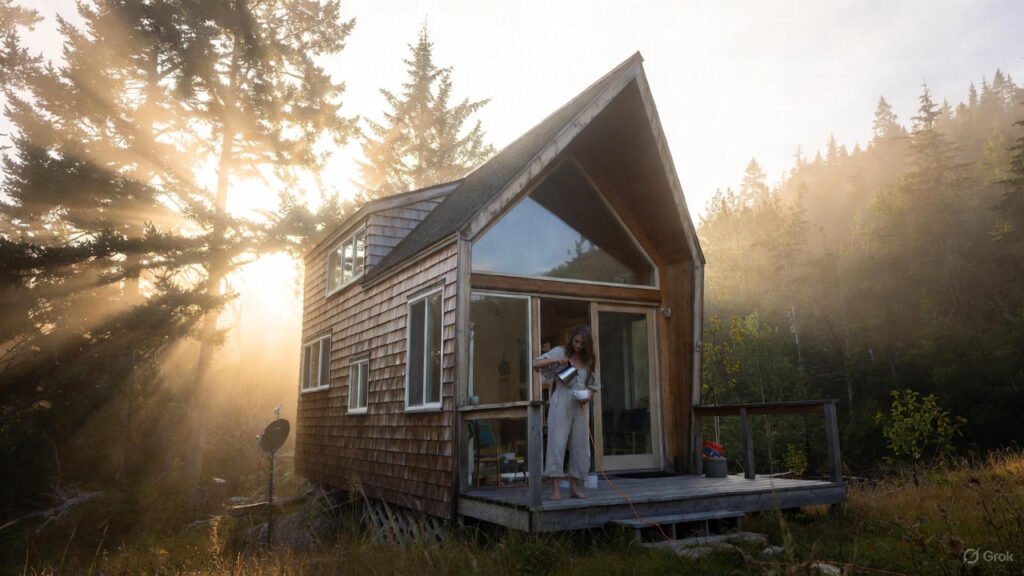
Fake off-grid has become Instagram’s favourite performance. October 2024, coastal British Columbia. A golden-hour drone shot glides over a cedar-shingled tiny house. A woman in linen pours coffee from a kettle that was definitely heated on a two-burner propane stove she never mentions. The caption reads: “Day 487 off-grid. No bills, no boss, just birdsong and bread baked in the clay oven we built with our own hands. Who’s ready to join us? #OffGridLife #Freedom” 150,000 likes in six hours. Heart emojis rain down like a monsoon.
Forty-two days later the same account goes live from the passenger seat of a rescue helicopter. Tears streak the lens. “Guys… the solar failed… we only had two days of batteries… please pray for the cats.” Chat explodes: “I thought you were off-grid??” She whispers, “We are… mostly.” The truth trickles out in the replies: the “solar panels” were largely decorative. Real power came from a buried orange extension cord snaking 200 yards through salal to a neighbor’s garage.
That single livestream killed more fake off-grid dreams than a decade of winter storms. Because if you can still find them crying on 4G, they were never lost to begin with.
Act I: When the Word Still Meant Something (2019–2021)
Before it was a filter, “off-grid” tasted like diesel on your fingers and frostbite at 4 a.m. while you coaxed a Lister generator back to life. It smelled like wet cedar shavings in a chainsaw mill you built yourself. It sounded like absolute silence after you threw the main breaker for the last time and the refrigerator finally shut up forever.
In the summer of 2020 a Google engineer who still refuses to be fully named sold his condo in Mountain View, bought forty acres outside Missoula for cash, and drove away in a 1996 Dodge van with $38,000 of lithium batteries in the back. His final tweet, December 31, 2020: “Panels up. Well at 82 feet. Deleting this account in 3… 2… 1…” The account still exists. Zero tweets. Zero followers left. A perfect score.
Act II: The Exodus and the Velocity of Panic
Realtors called it the “Corona Exodus.” Market data confirms the hysteria: rural land sales across the American West jumped as much as 68 % in 2020–2021, with many deals all-cash, no MLS listing, no forwarding address. They weren’t just running from a virus; they were reacting to the fragility of modern systems. They weren’t running toward safety; they were running toward silence.
Act III: Enter the Performers and “Curated Resilience”
The algorithm noticed the anxiety. This marked the explosion of fake off-grid performative asceticism. Silence became a commodity. Brands like EcoFlow and Jackery didn’t just sponsor creators; they manufactured an entire genre. We are no longer watching survival—we are watching curated resilience. The mud is real, but the struggle is staged. It is the commodification of vulnerability, packaged in 4K for an audience too exhausted to leave their apartments.
The comments write themselves: “Living my dream!!” “Take me with you!!” Meanwhile the real ones watched from the ridges, shook their heads, and quietly changed their vocabulary. They stopped saying “off-grid.” They started saying “gone feral,” “radio silent,” or “ghoststeading.” Because once a word goes viral, it dies.
Act IV: The High-Latency Content Farmers
By 2024 the playbook was printed in Shenzhen and shipped with every portable power station: buy $3,000 of budget gear, rent a cute A-frame for $800/weekend, film 47 nearly identical sunsets, and sell a $497 course titled “Escape the Matrix in 90 Days.”
With nearly 5 million Starlink terminals now in the wild, the definition of “remote” was rewritten overnight—and fake off-grid became technically impossible to spot without an extension-cord hunt.
One couple in the Okanagan Valley cleared $420,000 in 2024 teaching people how to live without money—while paying their video editor in Lisbon on the 1st of every month. Their “off-grid” cabin has a buried 200-amp service line, and a Tesla Model Y is hidden behind a fake woodpile for grocery runs.
Even the hospitality industry pivoted. A boutique spot in the Hudson Valley hangs Edison bulbs from “solar” batteries that are charged every night from the wall. The sign reads “Off-Grid Experience.” The owner laughed: “Bro, the espresso machine alone pulls 1,800 watts. We’re off-grid the way craft beer is non-alcoholic. It’s a vibe, not a utility plan.”
Act V: The Ones Who Actually Disappeared
But something beautiful is happening in the blind spots.
In the high desert of Terlingua, Texas, satellite imagery shows new driveways appearing and then disappearing under blown sand within months—someone learned to drag a cedar branch behind their truck to scrub their tracks. In the Patagonia cordillera, an entire valley of 27 families shares three Starlink dishes mounted on fake eagle nests. They have a rule: if you post a photo that reveals the river or the ridgeline, you’re out.
Starlink traffic analysis tells the story best. Of the millions of active terminals across rural North America, estimates suggest that 35–40 % have never uploaded a single photo or video—just quiet downstream for seed catalogs, pump manuals, and the occasional encrypted line: “Package received. Radio silence resumes.”
They are out there right now—tens of thousands, maybe hundreds of thousands—living on land you can’t find on Zillow anymore because they paid a teenager twenty bucks to scrub the parcel lines. They are not preppers with bunkers full of ammo. Most are just tired parents, burned-out coders, and quiet nurses who watched the hospitals collapse in 2020 and decided the next collapse wouldn’t catch them on a ventilator waiting for the grid to reboot.
You will never see their sunrise. You will never taste their bread. And that is exactly how they know it worked.
Epilogue: The Litmus Test
Open Instagram. Type #OffGridLife. Scroll for thirty seconds. Every single thumbnail is perfectly lit, perfectly framed, perfectly impossible.
Now try to find the engineer who posted on December 31, 2020, about his well hitting water at 82 feet. Account suspended. Profile picture gone. Trail cold.
In an era of hyper-surveillance and constant connectivity, anonymity is the new luxury. That’s the only off-grid flex that still matters in 2025: the moment the internet forgets your name.
The loudest voices shouting “off-grid” are still holding the cord. The quiet ones? They’re not hiding. They’re home.